Beer is a fermented drink made from grain. That is the whole definition. Wine is fermented fruit, mead is fermented honey, and beer is fermented grain, almost always malted barley, flavored with hops.
People have been brewing it for thousands of years. Some of the oldest written records we have, from ancient Mesopotamia, mention beer, and archaeologists have found traces of grain-based brewing even older than that. It may be one of the first things humans ever made on purpose.
What follows is how a modern brewery turns a sack of grain into the beer in your glass, step by step.
Barley straight from the field is no good for beer. Its energy is locked up as starch, and yeast cannot eat starch.
So the grain is malted first. It is soaked in water until it begins to sprout, which wakes up enzymes inside the kernel. Then it is dried in a kiln to stop the sprouting. Kiln it gently and you get pale malt. Kiln or roast it harder and you get darker malts with caramel, chocolate and coffee flavors.
Most breweries buy their malt from a maltster rather than making it. If you want the detail on grain, hops, water and yeast, our guide to beer ingredients goes deeper.
The brewer cracks the malt in a mill, just enough to open the husks, then mixes it with hot water in a vessel called a mash tun. This porridge is the mash.
Held at around 145 to 158°F for about an hour, the enzymes in the malt get to work and turn the starch into sugar. Lower temperatures make more fermentable sugar and a drier, lighter beer. Higher temperatures leave more body and sweetness. This is one of the brewer's first big decisions.
The sweet liquid is drained off the grain and the grain bed is rinsed with more hot water to collect every bit of sugar. The liquid is now called wort, pronounced "wert". It tastes like a sweet, malty tea.
The spent grain does not go to waste. Many breweries give it to farmers for animal feed.
The wort goes into a kettle and is boiled, usually for 60 to 90 minutes. Boiling sterilizes it and concentrates it, and this is when the hops go in.
At the end of the boil, many brewers spin the wort in a whirlpool to gather the hop and grain debris in the middle, and add more hops for aroma.
Yeast would die in boiling wort, so the wort is cooled quickly, then moved to a fermenter, and the yeast is added. Brewers call this pitching.
Over the next days, the yeast eats the sugar and makes alcohol and carbon dioxide, along with hundreds of flavor compounds. This is the moment the sweet tea becomes beer.
That one choice of yeast and temperature decides whether a beer is an ale or a lager. Our post on ale vs lager vs IPA vs stout explains what that means in the glass.
Fresh from fermentation, beer is "green". It needs time to settle and round out. Ales might condition for a week or two. Lagers are stored cold for weeks, sometimes months, which is where the name comes from: lagern is German for "to store".
This is also when brewers dry hop IPAs, adding hops to the finished beer for a big burst of aroma, or add fruit, coffee or oak.
Beer gets its bubbles one of two ways. Most breweries add carbon dioxide directly in a sealed tank. Some let the beer finish fermenting in the bottle or keg, so the yeast makes the bubbles naturally, the way Belgian brewers and many farmhouse brewers do.
Then it goes into kegs, cans or bottles. Many craft beers are not filtered or pasteurized, which is why they taste best fresh and why we keep them cold.
From grain to glass, a simple ale can be ready in two to three weeks. A lager usually takes four to eight. Barrel-aged and wild beers, like the ones Oregon's de Garde Brewing in Tillamook is known for, can take a year or more.
Every brewery we pour follows these same steps, but no two do them alike. That is the fun of it. Ballard has a whole brewery district, with many breweries within walking distance of us: Reuben's Brews, Stoup Brewing, Fair Isle Brewing, Urban Family Brewing and Lucky Envelope Brewing among them. Across the city you have Fremont Brewing, Cloudburst Brewing downtown, Georgetown Brewing, Hellbent Brewing in Lake City, Rooftop Brewing and Machine House, along with Kings & Daughters down in Portland. Each of them makes different choices at every step, and you can taste it.
What is beer made of? Water, malted grain (usually barley), hops and yeast. Some beers add other grains, fruit, spices or coffee, but those four are the base.
How long does it take to make beer? About two to three weeks for a simple ale, four to eight weeks for a lager, and a year or more for barrel-aged and wild beers.
Is beer fermented? Yes. Yeast ferments the sugar from malted grain into alcohol and carbon dioxide. Without fermentation, it would just be sweet malty water.
What is the difference between beer and wine? Beer is fermented from grain, wine from fruit, usually grapes. Grain has to be malted and mashed first to turn its starch into sugar. Grapes already contain sugar.
What does wort mean? Wort is the sweet liquid drained from the mashed grain, before the yeast turns it into beer.
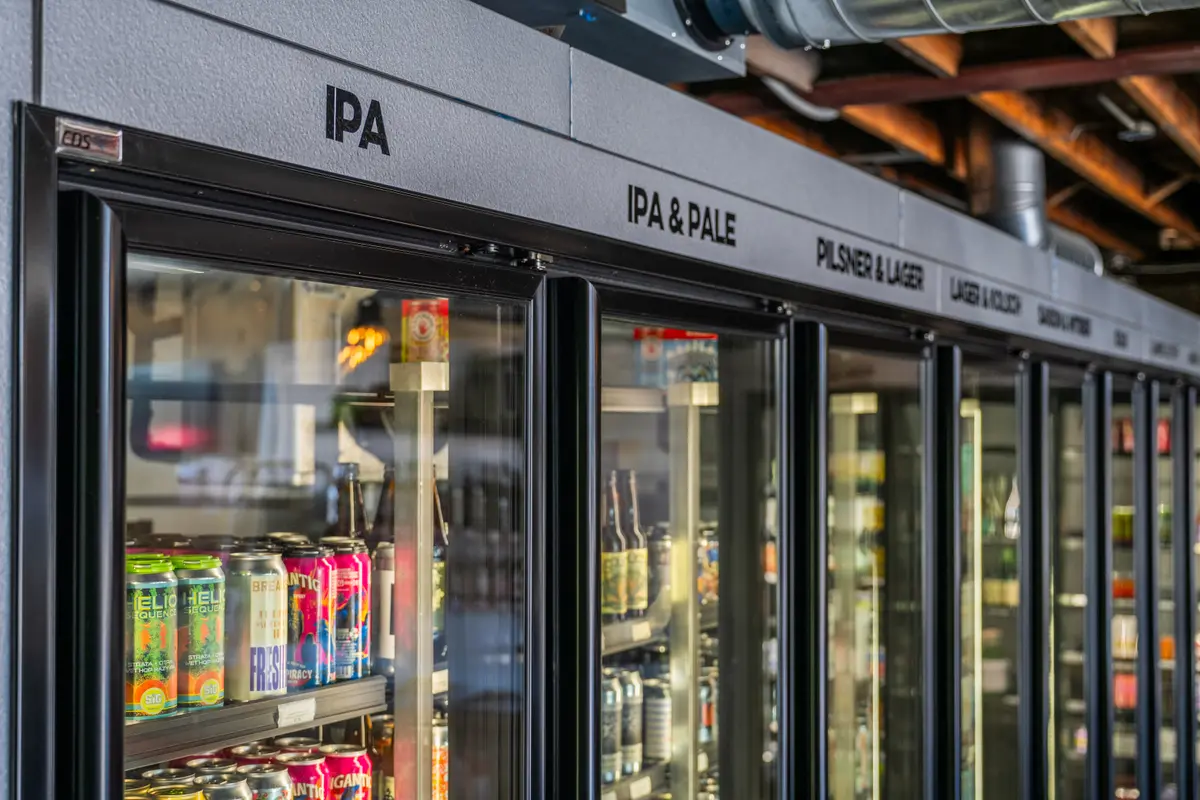
We are at 2446 NW Market St in Ballard. We pour fourteen rotating taps in 5, 8 and 16 ounce sizes, so you can try a few without committing to a pint, and the current list is always on our Untappd page. There is a fourteen-door fridge of cans and bottles to take home, with a proper non-alcoholic shelf, or drink any can here for $2 corkage.
Eat something with it: pizza on organic Washington flour dough, made fresh here. Families are welcome, dogs are welcome inside and on the patio, and the patio is where you want to be on a dry day.
What is on tap · Types of beer: the full guide · See the menu


