These four words cover most of what you will see on a tap list, and they cause more confusion than anything else we get asked about. Part of the trouble is that they are not four equal things. Two of them are families, and two of them are styles that live inside one of those families.
Here is the short version, then the long one.
So an IPA and a stout are both ales. A lager is neither. And yes, that means "ale vs IPA" is a little like asking "fruit vs apple".
Every beer is brewed the same way at the start. Malted grain is steeped in hot water to make a sweet liquid called wort. Hops go in for bitterness and aroma. Then yeast is added, and the yeast decides which family the beer belongs to.
Ale yeast likes it warm, around 60 to 72°F. It works fast, often finishing in a week or two, and while it works it gives off fruity and spicy flavors. Ales tend to taste fuller and more aromatic.
Lager yeast likes it cold, around 45 to 55°F. It works slowly, and then the beer is stored cold for weeks to settle and smooth out. "Lager" comes from the German word for storing. Lagers taste cleaner and crisper, so the malt and hops show through more plainly.
How to tell them apart in the glass: you often cannot by color. There are pale ales and black lagers. Taste is the better guide. If it is crisp, clean and snappy, it is probably a lager. If it is rounder, fruitier or more aromatic, it is probably an ale.
IPA stands for India Pale Ale. The story goes that English brewers sent strongly hopped pale ales to India in the 1800s, because hops help preserve beer on a long voyage. Historians argue about the details. What matters now is what the word means on a tap list: a pale ale with the hops turned up.
A modern IPA usually runs 6 to 7.5% alcohol and comes in a few main shapes:
IPAs feel at home in the Pacific Northwest for a reason. Washington's Yakima Valley grows most of America's hops. Reuben's Brews, a few blocks from us in Ballard, and Hellbent Brewing in Lake City both make IPAs that people cross town for. From Portland, Kings & Daughters brews hop-forward beers that are more delicate and often lower in alcohol.
A stout is a dark ale built around roasted grain, usually roasted barley. That roast gives the coffee and dark chocolate flavors and the near-black color.
Dark does not mean heavy or strong. A classic Irish dry stout is often only around 4 to 4.5%, lighter in alcohol than most IPAs. The heavy ones are the imperial stouts, which can reach 10% or more and are often aged in bourbon barrels.
Stouts come in a few main kinds:
Stout vs porter: the line between them is blurry, and brewers argue about it. As a rule of thumb, stouts lean more on roasted barley and taste more like coffee, and porters lean on chocolate malt and taste smoother and more like chocolate.
Ale. Warm-fermented. Rounder, fruitier, more aromatic. Any color. Usually 4 to 7%.
Lager. Cold-fermented and cold-stored. Clean, crisp, smooth. Any color, most often pale. Usually 4 to 5.5%.
IPA. An ale. Pale gold to orange. Hoppy, from piney and bitter to juicy and soft. Usually 6 to 7.5%.
Stout. An ale. Black. Coffee, chocolate, roast. From about 4% to well over 10%.
This is our favorite part.
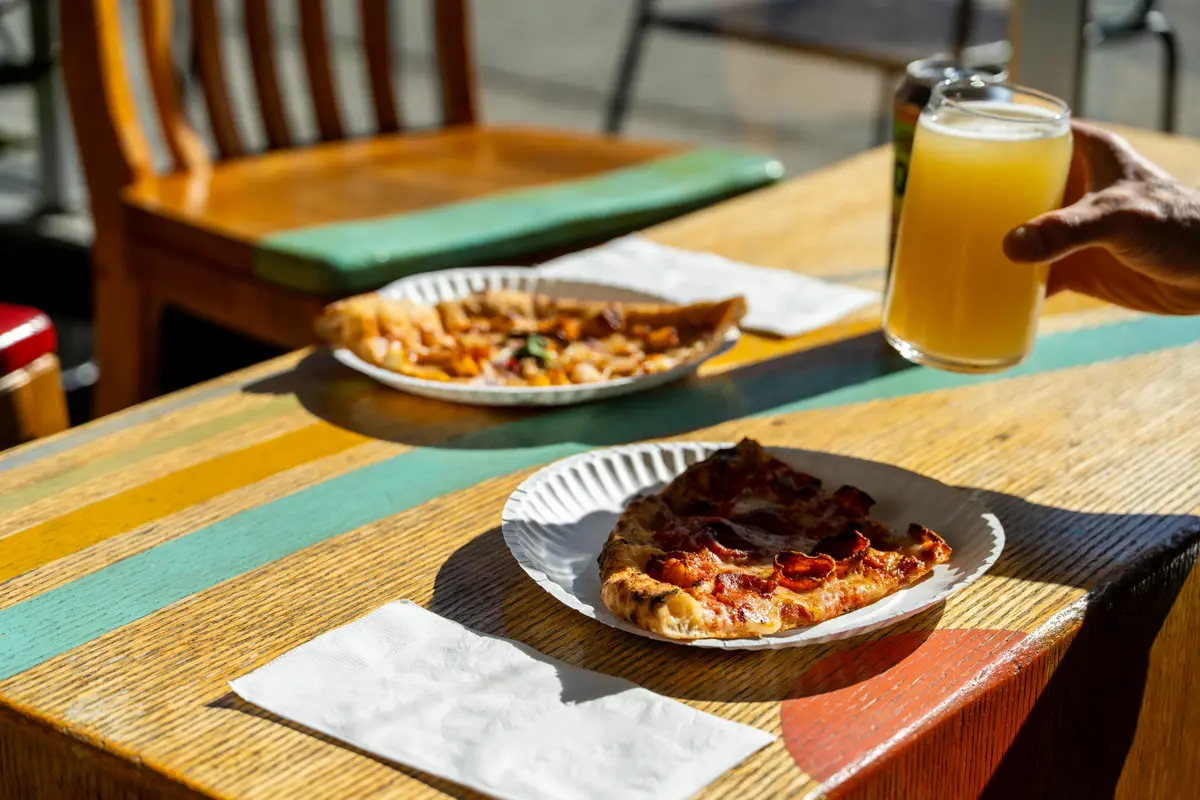
Every pizza is made fresh here on organic Washington flour dough. Pull the edge off a slice and taste it plain. Then drink.
Is IPA an ale or a lager? An ale. IPA stands for India Pale Ale. There is a style called India Pale Lager, an IPA made with lager yeast, but it is much less common.
Is stout an ale or a lager? An ale. Its dark color and flavor come from roasted grain, not from the yeast.
Which is stronger, ale or lager? Neither, as families. Strength depends on the style. Most everyday lagers sit around 4 to 5.5%. IPAs usually run 6 to 7.5%. A dry stout can be lighter than both.
Which has fewer calories, ale or lager? Calories follow alcohol and body more than family. Light lagers and session beers are the lightest. Imperial stouts and double IPAs are the heaviest.
Is Guinness an ale or a lager? Guinness Draught is a stout, so it is an ale. At around 4.2%, it is lighter than most people expect.
We are at 2446 NW Market St in Ballard, with fourteen rotating taps from Washington and Oregon and further afield. Bring the family, bring the dog, and take a table on the patio when the weather is with us. Dogs are welcome inside too.
What is on tap · Types of beer: the full guide · See the menu


