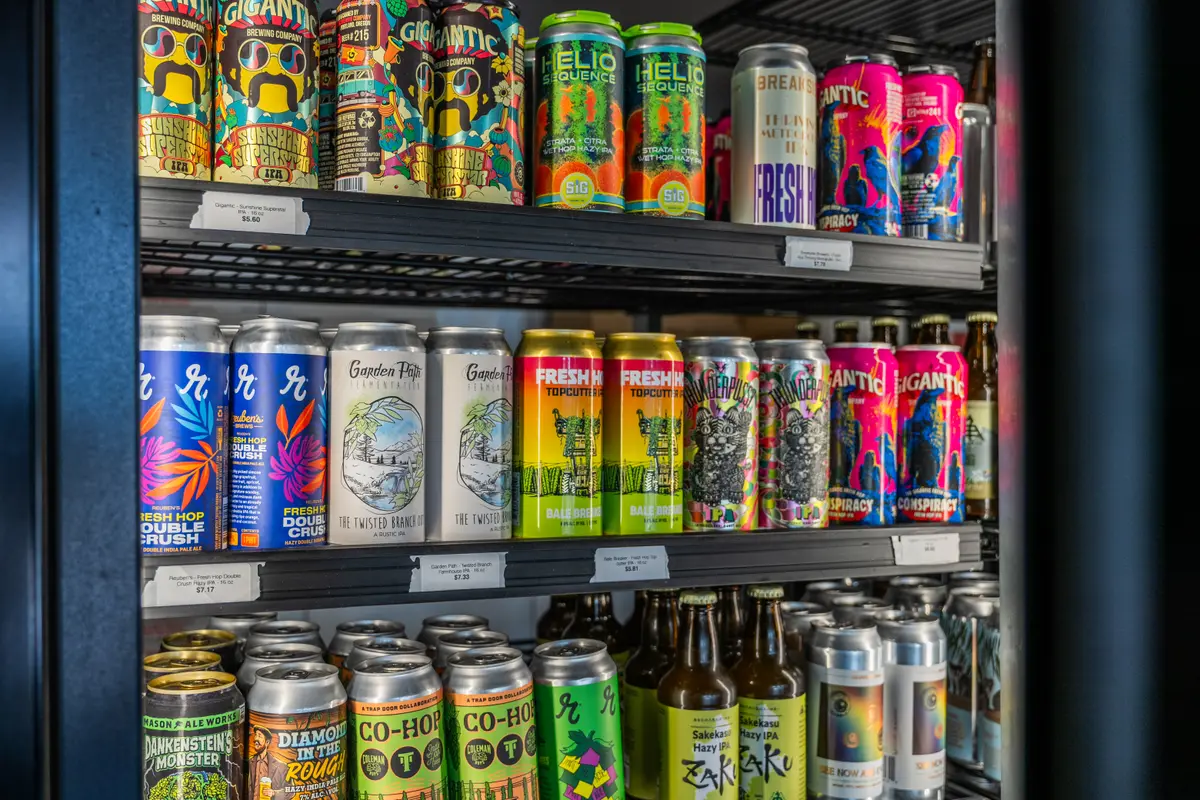
Every beer in the world comes down to four things: water, malted grain, hops and yeast. What a brewer does with those four is where it gets interesting. Change the yeast and you change the whole family the beer belongs to. Roast the malt darker and you get coffee and chocolate. Add hops late in the boil and you get grapefruit and pine.
We pour fourteen taps here in Ballard, and they change constantly. People ask us every day what something is, or what they should try if they liked the last thing. This is the long answer, written the way we would explain it across the bar.
Almost every beer is either an ale or a lager. The difference is the yeast.
Ales use yeast that works warm, at roughly 60 to 72°F, and fast. Warm fermentation throws off fruity and spicy flavors, so ales tend to taste rounder and more aromatic. IPAs, stouts, porters, wheat beers, Belgian styles and most sours are ales.
Lagers use yeast that works cold, closer to 45 to 55°F, and slowly. Then the beer rests cold for weeks. The result is cleaner and crisper, with the malt and hops showing through without much fruit from the yeast. Pilsners, helles, Mexican-style lagers and dark lagers like schwarzbier all belong here.
Neither is better. An ale is often louder. A good lager is harder to make, because there is nowhere for a mistake to hide. More on that in ale vs lager vs IPA vs stout.
Pale gold, crisp, with a clean bready malt and a firm, slightly floral or spicy hop bite. Czech pilsners are rounder and softer. German pilsners are drier and snappier. If you think you do not like beer, start here, with a fresh one from a brewery that cares about it.
The Munich answer to pilsner. Soft, gently sweet, with less hop bite. It is the beer you can drink all afternoon on a patio, which is exactly what it was made for.
Very pale and very clean, often brewed with some corn or rice to keep the body light. Built for heat, salt and lime. Craft brewers around Seattle make excellent versions every summer.
Toasty, a little caramel, still clean on the finish. Märzen is the classic Oktoberfest beer.
Looks like a stout, drinks like a lager. Roasty and chocolatey but light-bodied and dry. A great one to hand someone who swears they do not like dark beer.
Strong, rich, malty lagers, often 6 to 8% and above. Bread crust, toffee, dark fruit. Winter beers.
The beer that started American craft brewing. Balanced, with enough hops to taste citrus and pine but enough malt to keep it easy. A good test of a brewery.
Clear, dry and properly bitter, with resin, pine and grapefruit. The Pacific Northwest grows most of the hops in the country, mostly in Washington's Yakima Valley, so this style feels like home here. Reuben's Brews, a few blocks from us in Ballard, makes some of the best-known IPAs in the state.
Also called New England IPA. Cloudy, soft and juicy, tasting of mango, passion fruit and orange, with much less bitterness than a West Coast IPA. The haze comes from oats, wheat and huge late additions of hops.
More of everything: more malt, more hops, more alcohol, usually 8% and up. Big, sticky and best in a small pour.
All the hop aroma, less alcohol, usually under 5%. For when you want a second one.
Our favorite few weeks of the year. Hops normally get dried before brewing. In late summer and early autumn, Northwest brewers rush them from the field in Yakima straight into the kettle, often within a day of picking. The beer tastes green, bright and alive, and it is gone in weeks.
German wheat beer. Hazy, soft, tasting of banana and clove from the yeast rather than from anything added.
Belgian wheat beer brewed with coriander and orange peel. Light, a little spicy, very refreshing.
Cleaner than either of the above, without the banana or spice. Often a base for fruit.
Originally brewed on farms for the workers. Dry, peppery, fruity and very bubbly. One of the most food-friendly beers there is, and wonderful with pizza.
Belgian abbey styles. A dubbel is dark and fruity, a tripel is golden, strong and spicy, and a quad is dark, rich and strong. Classics like St. Bernardus show up on our taps when we can get them.
Nutty, toasty, a little caramel. Gentle and underrated.
Chocolate, light roast, smooth body. Porters lean on chocolate and dark malts for their color and flavor.
Darker and more roast-forward than porter, usually built around roasted barley, with coffee and dark chocolate up front. Dry stout is light and crisp. Oatmeal stout is silky. Milk stout has lactose for sweetness. Imperial stout is big, strong and often aged in bourbon barrels.
Light, tart German wheat beers. Gose adds salt and coriander. Both are often brewed with fruit.
Belgian beers fermented by wild yeast and bacteria, then aged for years. Funky, sour and complex. We keep Cantillon bottles when we can get them.
Brewers here use the same wild methods with local fruit and barrels. Oregon's de Garde Brewing in Tillamook is one of the best in the country.
Not beer, but you will find them on most tap lists, including ours. Cider is fermented apples. Mead is fermented honey. Hard seltzer is a neutral base with fruit. Washington grows more apples than any other state, so local cider is a real strength.
Most of what we pour comes from Washington and Oregon. A few breweries you will see on our taps:
The list changes every week. The current taps are always on our Untappd page.
The easiest way to learn is to taste a few side by side. We pour every beer in 5, 8 and 16 ounce sizes, so you can try three or four different styles without committing to a pint of any of them. Ask us for a taste of anything. We are happy to pour one.
How many types of beer are there? The Beer Judge Certification Program lists more than 100 styles. They all sit inside a few families: lagers, pale ales and IPAs, wheat beers, Belgian and farmhouse ales, dark ales, and sours.
What is the most popular type of beer? Pale lager, by a long way, worldwide. In craft beer, IPA has been the best seller for years.
What is the difference between an ale and a lager? The yeast and the temperature. Ales ferment warm and fast and taste fruitier. Lagers ferment cold and slow and taste cleaner.
Which type of beer is the lightest? Light lagers, Mexican-style lagers and session beers are lightest in body and alcohol. Color is not a guide: a schwarzbier is black but lighter than many golden IPAs.
Is stout stronger than other beers? Not necessarily. A classic Irish dry stout is often around 4 to 4.5%, lighter than most IPAs. Imperial stouts are the strong ones.
We are at 2446 NW Market St in Ballard. Fourteen rotating taps, natural and organic wine, and pizza on organic Washington flour dough, made fresh here. Families are welcome, dogs are welcome inside and on the patio, and the patio is the best seat in the neighborhood when the sun is out.


