Two beers can both be golden, both be 5%, and taste nothing alike. One is bready and soft, the other bitter and piney, a third smells of banana. None of that is an accident. Every flavor in a beer comes from a specific place, and once you know where, you can find the beers you love much faster.
Here is where each one comes from.
Bitterness comes almost entirely from hops. Hop cones contain alpha acids, which do not taste of much until they are boiled. The longer the hops boil, the more bitter the beer.
Brewers measure bitterness in IBUs, International Bitterness Units. A light lager might sit around 10. A West Coast IPA can be 60 or more. But IBUs only tell half the story. Malt sweetness balances bitterness, so a sweet, strong beer with high IBUs can taste less bitter than a dry one with fewer.
The Pacific Northwest knows bitterness well. Washington's Yakima Valley grows most of America's hops, and the classic West Coast IPA, clear, dry and properly bitter, grew up here. Reuben's Brews in Ballard and Hellbent Brewing in Lake City both make the kind of IPA that explains the style in one sip.
If you find beer too bitter: try a hazy IPA, which uses huge amounts of hops late in the process for aroma and juice rather than bitterness. Or a helles or a wheat beer.
Sweetness and body come from malt. During brewing, enzymes in the malted grain turn starch into sugar. Yeast eats most of it, but some sugars are too complex for yeast, and those stay behind to give body and sweetness.
"Malty" covers a whole range of flavors depending on how the malt was kilned:
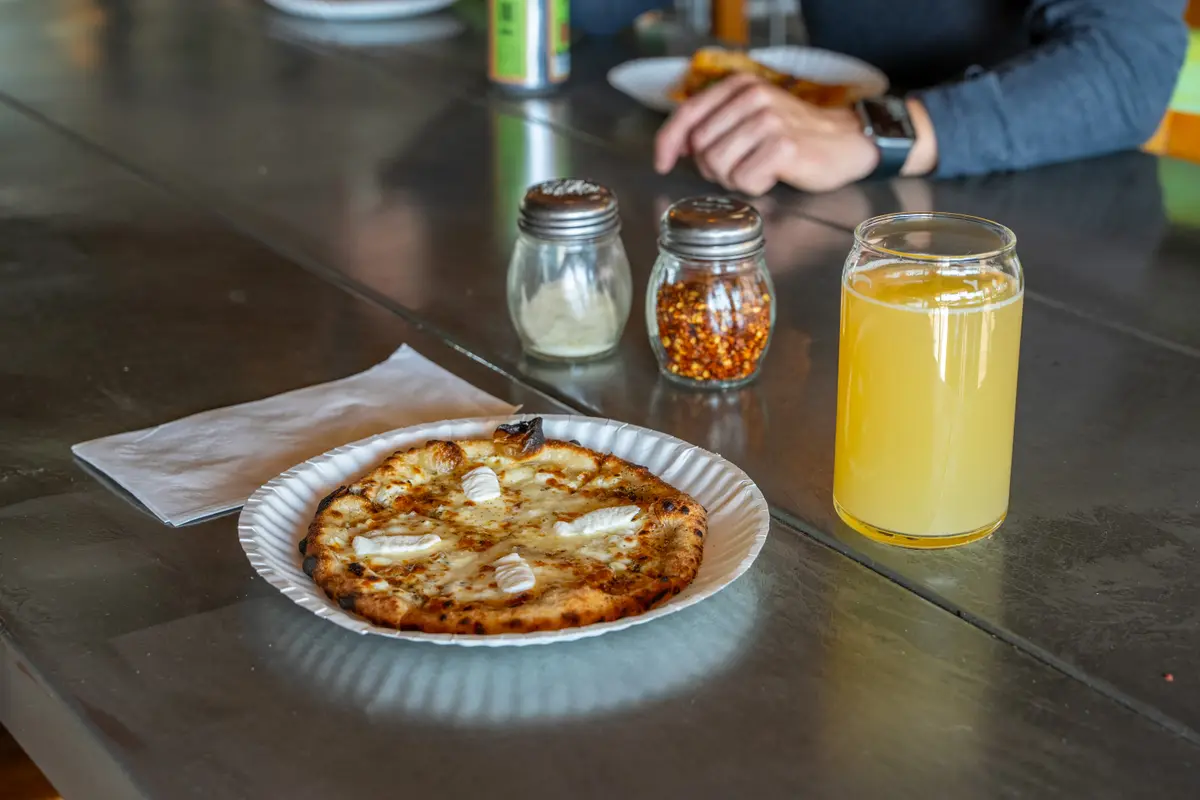
Malty beers include amber lagers, Märzen, brown ales, bocks and Scotch ales. If you like the crust of a good loaf of bread, you probably like malt. We can relate: our pizza dough is made on organic Washington flour, and the crust is where most of its flavor lives.
Coffee, dark chocolate, burnt toast and cocoa come from grain that has been roasted hard, like black malt, chocolate malt and roasted barley. A little gives color and a hint of roast. A lot gives the full espresso hit of a stout.
Roast is often confused with heaviness, but they are not the same thing. A dry Irish stout is roasty and light. A schwarzbier, a German black lager, is roasty and crisp. Roast is a flavor, not a weight.
Fruit flavor in beer comes from two very different places.
Yeast. As it ferments, yeast makes compounds called esters, which taste fruity, and phenols, which taste spicy. Warm-fermented ales make lots of them.
Hops. Modern hop varieties carry huge amounts of fruit: grapefruit, orange, mango, passion fruit, pineapple, lychee. When a hazy IPA tastes like juice, there is usually no fruit in it at all, only hops.
And sometimes, of course, there really is fruit in it. Brewers add raspberries, cherries, peaches and citrus, especially to sours.
Sourness comes from acid, usually lactic acid made by bacteria like Lactobacillus, sometimes with wild yeast like Brettanomyces adding funk, leather and barnyard notes.
If you like dry white wine or a good sourdough, sour beer is worth a try.
How a beer finishes depends on how much sugar the yeast left behind. A dry beer leaves your mouth clean and makes you want another sip. A sweet beer lingers. Brewers control this through the mash temperature, the yeast and the grains they choose.
Taste is not only flavor. Body ranges from thin to full, and carbonation from soft to prickly. Oats and wheat make a beer silky. High carbonation makes it lively. A pint of stout poured with nitrogen feels creamy because nitrogen bubbles are tiny.
You do not need a special vocabulary. You need three things: a few beers side by side, small pours, and attention.
1. Look. Color and clarity hint at the malt and the style. 2. Smell. Give it a swirl and breathe in. Most of what we call taste is really smell. 3. Sip and hold it. Notice the first taste, then what happens in the middle. 4. Swallow and wait. Is the finish dry or sweet? Does bitterness build? Does anything linger? 5. Compare. One beer alone tells you little. Three side by side teach you a lot.
This is exactly why we pour every one of our fourteen rotating taps in 5, 8 and 16 ounce sizes. Order three 5 ounce pours, say a pilsner, an IPA and a stout, and in ten minutes you will know more about your own taste than any article can tell you. Ask for a taste of anything you are unsure about.
Why does beer taste bitter? Because of hops. Hops contain alpha acids that become bitter when they are boiled. The longer they boil, the more bitter the beer.
What does malty mean in beer? Flavors from malted grain: bread, crackers, caramel, toffee, toast and nuts. Malty beers tend to be fuller and sweeter.
Why does some beer taste like banana? That is the yeast. Some ale yeasts, especially the ones used in German wheat beers, make a compound called isoamyl acetate, which smells and tastes like banana.
Why does some beer taste like fruit without any fruit in it? Modern hop varieties are full of fruity aromas like citrus, mango and passion fruit, and some yeasts add fruity notes too.
What is the least bitter type of beer? Wheat beers, helles, light lagers, many hazy IPAs, fruited sours and most stouts with a sweeter finish are all low in perceived bitterness.
We are at 2446 NW Market St in Ballard. The current taps are always on our Untappd page, and our fourteen-door fridge holds a lot more: usually around 30 different IPAs, 30 lagers and 40 to 50 other styles, plus a proper non-alcoholic shelf. Drink any can here for $2 corkage.
Bring the family, bring the dog, inside or on the patio. Pair a flight with pizza on organic dough, made fresh here.
What is on tap · Types of beer: the full guide · See the menu


