The internet is full of articles listing the health benefits of beer. We are not going to write another one. Beer contains alcohol, and no glass of beer is a health food, however good the hops.
What we can do is tell you plainly what is in a craft beer, so you can choose well. We are a taproom, not doctors, and nothing here is medical advice. If you have a health question about drinking, ask your doctor.
ABV means alcohol by volume, the percentage of the beer that is alcohol. It matters more than anything else on the label, and craft beer varies a lot.
A 16 ounce pour of a 7% IPA has a lot more alcohol than a 12 ounce can of a 4.5% lager. Two pints of double IPA is not the same evening as two pints of pilsner. Read the ABV, and adjust.
Most of the calories in beer come from alcohol, with the rest from leftover sugars and body. A rough rule: the higher the ABV and the fuller the body, the more calories.
Craft breweries rarely print calories, so use ABV and body as your guide.
Most beer contains gluten, because it is brewed from barley and often wheat.
We almost always have gluten-free beer in the fridge, alongside cider on tap and in the fridge, and a hard seltzer is often on draft. In the kitchen, our cheese and sauce are gluten-free, but our pizza dough is not, and we would rather say so plainly than have you make the trip for nothing.
This is the real good news of the last few years. Non-alcoholic beer is no longer a sad compromise. There are NA IPAs, lagers, stouts and wheat beers that taste like the real thing, made by brewers who clearly care.
Most are under 0.5% ABV. Many have far fewer calories than regular beer. People choose them for all sorts of reasons: driving, training, pregnancy, medication, a dry month, or just not wanting a drink tonight. Nobody needs to explain.
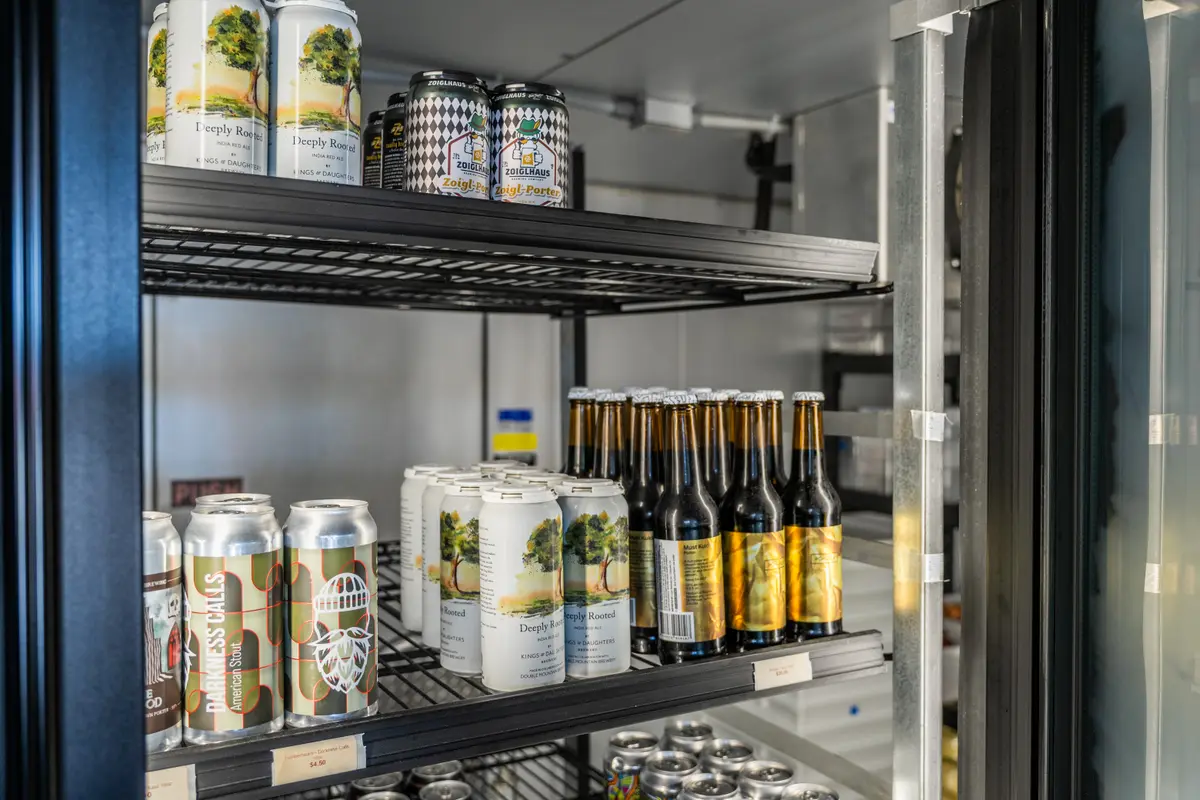
We keep a proper non-alcoholic shelf in our fourteen-door fridge, not a single token can. Take it home, or we will open it for you to drink here.
The easiest way to drink less and enjoy it more is to pour less.
We pour every one of our fourteen rotating taps in 5, 8 and 16 ounce sizes. Three 5 ounce pours is less beer than a single pint, and you get to taste three different beers instead of one. A 5 ounce pour of a strong imperial stout is exactly how that beer is meant to be drunk.
You do not need a pint to be part of the table.
Drinking with food slows down how fast alcohol reaches your bloodstream. It also makes the beer taste better. Our pizza is made fresh here on organic Washington flour dough, with a Caesar salad alongside. The dough is simple: flour, water, yeast, salt and oil.
Public health guidance in the United States asks adults who drink to do so in moderation, and to drink less rather than more. In the US, a standard drink is about 12 ounces of 5% beer, so a pint of a strong craft beer can count as two or more.
Is craft beer healthy? No alcoholic drink is a health food. Craft beer can be part of a balanced life in moderation, but we would not drink it for your health. If you have questions about alcohol and your health, talk to your doctor.
How many calories are in a craft beer? It depends mainly on the alcohol and body. Light lagers and session beers are lowest. IPAs are higher. Strong stouts and double IPAs are highest. Breweries rarely print calories, so use the ABV as a guide.
What does ABV mean? Alcohol by volume, the percentage of the drink that is alcohol. A 6% beer is 6% alcohol.
Is there gluten in craft beer? Most beer contains gluten from barley and wheat. Look for beers labeled gluten-free, or choose cider or hard seltzer. We almost always have gluten-free beer in our fridge. Gluten-reduced beer is not the same as gluten-free.
Is non-alcoholic beer really alcohol-free? Most non-alcoholic beer contains a trace, usually under 0.5% ABV. Beers labeled 0.0% contain none or almost none.
We are at 2446 NW Market St in Ballard. Fourteen rotating taps, a fourteen-door fridge with a proper non-alcoholic shelf, cider, wine and pizza on organic dough. Families are welcome, dogs are welcome inside and on the patio, and the patio is the best seat in the neighborhood on a dry afternoon. Today's taps are on our Untappd page.
What is on tap · Types of beer: the full guide · See the menu


